Asset Management vs Wealth Management: What’s the Difference?
but they solve different problems.
Asset management is primarily concerned with managing a defined pool of capital within an agreed investment mandate. Wealth management takes a broader view, looking at how a client’s investments fit within their overall wealth, liquidity needs, ownership structures and long-term objectives.
In practice, the clearest distinction is one of scope.
The wealth manager looks across the whole wealth picture. The asset manager is typically responsible for a specific investment mandate within it.
That difference becomes particularly important for private clients and families whose wealth may be spread across investment portfolios, businesses, property, private assets and cash rather than held in a single portfolio.
Asset Management vs Wealth Management in Practice
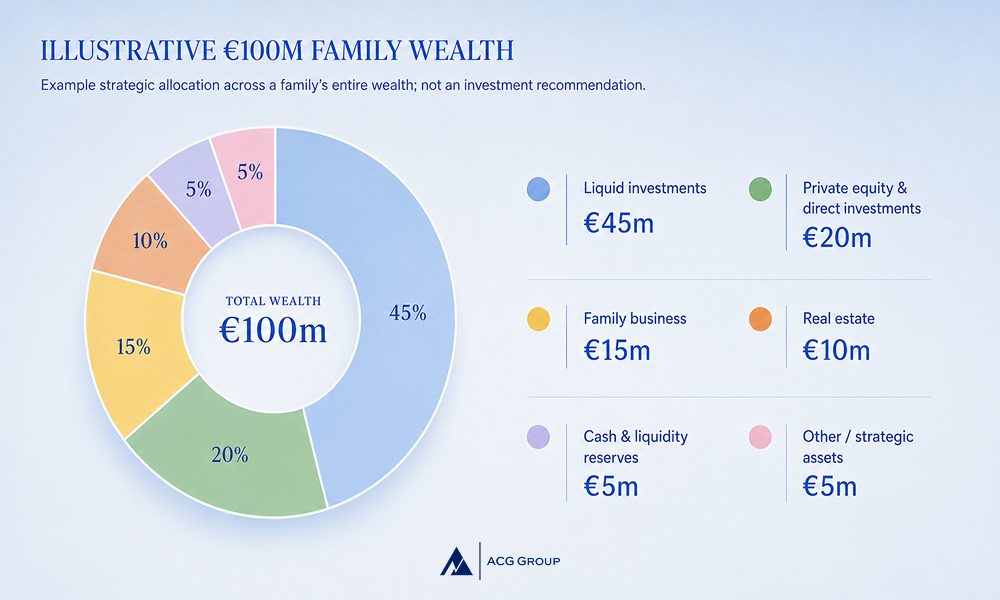
Only part of that wealth may be held in liquid investment portfolios. The rest could consist of a family business, private equity interests, property, strategic holdings or cash reserved for future requirements.
A wealth manager or family CIO would look at the entire €100 million when considering how capital should be allocated. This means taking into account not only expected investment returns, but also liquidity, concentration risk, future liabilities, family objectives and the need to preserve or transfer wealth over time.
An asset manager may instead be appointed to manage a specific part of that wealth – for example, a €45 million liquid investment portfolio.
Their responsibility is more specialised. The focus is on constructing and managing the portfolio in line with an agreed objective, risk profile and investment mandate.
Illustrative €100m Family Wealth
An illustrative allocation might include €45 million in liquid investments, €20 million in private equity and direct investments, €15 million in a family business, €10 million in real estate, €5 million in cash and liquidity reserves, and €5 million in other strategic assets.
The wealth manager considers how these components interact.
For example, if a large proportion of the family’s wealth is already tied to an operating business, adding further concentrated equity exposure within the liquid portfolio may increase overall risk more than the portfolio alone would suggest.
Similarly, significant future liquidity requirements – such as a property purchase, business investment or distribution to family members – could affect how much capital should remain liquid and how aggressively the investment portfolio should be positioned.
This is where wealth management extends beyond portfolio construction.
Where Asset Management Enters
Once the strategic allocation has been defined, the liquid investment portfolio can be managed through one or more specialist mandates.
For example, a €45 million portfolio might be divided between global equities for long-term growth, investment-grade bonds for stability and income, diversifying strategies to reduce dependence on equity markets, listed real assets for inflation-sensitive exposure and short-duration investments to preserve liquidity and optionality.
At this level, the asset manager is focused on the investment problem itself.
The questions become more specific: how should the portfolio be allocated, which securities or strategies should be selected, how much risk should be taken, how should liquidity be managed and whether the portfolio is delivering the intended outcome.
The asset manager’s responsibility is therefore usually defined by the portfolio mandate rather than by the client’s wider personal, family or ownership context.
Wealth Management: Managing the Broader Picture
For private clients and families, wealth is rarely only an investment portfolio.
A founder may have accumulated most of their wealth through a single company. Another family may have significant property exposure, private investments or assets spread across different jurisdictions. Some clients may be preparing for a business sale, while others may be thinking about succession to the next generation.
These situations create questions that extend beyond asset management.
Wealth Creation and Preservation
During the wealth creation phase, a client may be comfortable holding a concentrated position in a business or other high-growth asset.
Once significant wealth has been accumulated, however, priorities often change.
Protecting capital, diversifying sources of risk and creating a more resilient balance between growth and preservation may become increasingly important.
The role of wealth management is to recognise that transition and ensure that the investment strategy evolves with the client’s circumstances.
Liquidity Management
Liquidity is another practical example.
A portfolio may appear well diversified from an investment perspective but still be poorly aligned with the client’s actual cash requirements.
A client planning a major acquisition, tax payment, business investment or family distribution may need access to capital at a specific point in time. Wealth management therefore considers not only expected return, but also when capital may be required and how easily different assets can be converted into cash.
Tax Efficiency and Ownership Structures
Investment decisions also exist within legal and tax structures.
The wealth manager may therefore need to coordinate with tax, legal and other professional advisers to ensure that portfolio decisions are considered within the broader ownership framework.
This does not necessarily mean providing tax or legal advice directly. The value often lies in coordinating investment decisions with the specialists responsible for those areas.
Estate and Succession Planning
For families, investment decisions can also be affected by how wealth is expected to transfer between generations.
Different family members may have different objectives, time horizons or liquidity needs.
A portfolio designed solely around investment efficiency may therefore be inappropriate if it does not take account of succession plans or the future ownership of the assets.
This broader coordination is one of the areas where wealth management differs most clearly from a standalone asset management mandate.
Asset Management: Solving the Investment Problem
Asset management is narrower in scope, but that does not make it less sophisticated.
Its value lies in specialist management of investment capital.
A common example is portfolio concentration. An investor may hold a large exposure to a particular equity market, sector or group of securities because those assets have performed strongly over time. The result can be a portfolio that is much more vulnerable to a specific market event than the investor realises.
Asset management addresses this through portfolio construction, diversification and ongoing risk monitoring.
Another common issue is portfolio drift.
Over time, market movements can change the balance of a portfolio significantly. An allocation that was originally designed to deliver a particular risk profile may no longer behave in the same way.
Active portfolio oversight can identify these changes and rebalance the portfolio where appropriate.
Liquidity is also important at the asset-management level. A strategy may offer attractive expected returns, but if too much capital is committed to illiquid investments, the portfolio may struggle to respond to changing market conditions or investor withdrawals.
The same applies to asset allocation. A portfolio that combines several individually attractive investments may still be poorly constructed if those assets are exposed to the same underlying risk factors.
The asset manager’s role is therefore to convert an investment objective into a disciplined portfolio and manage it through changing market conditions.
Where Asset Management and Wealth Management Overlap
The two disciplines are not mutually exclusive.
In many cases, asset management sits inside the broader wealth management framework.
The wealth manager may establish the strategic objectives, determine how much capital should be allocated to different parts of the family’s wealth and select specialist managers to implement individual mandates.
The asset manager then focuses on delivering the investment objective for the capital entrusted to them.
This distinction can also explain why a single family may work with several asset managers at the same time. Different managers may be selected for equities, fixed income, private markets or specialist strategies, while the wealth manager retains oversight of how those mandates fit together.
The practical difference is therefore not simply that one service is broader than the other.
It is also a difference in perspective: wealth management begins with the client and their total wealth; asset management begins with the investment mandate.
The Infrastructure Behind Investment Management
Whether investments are managed within a standalone asset-management mandate or as part of a broader wealth-management relationship, implementation also matters.
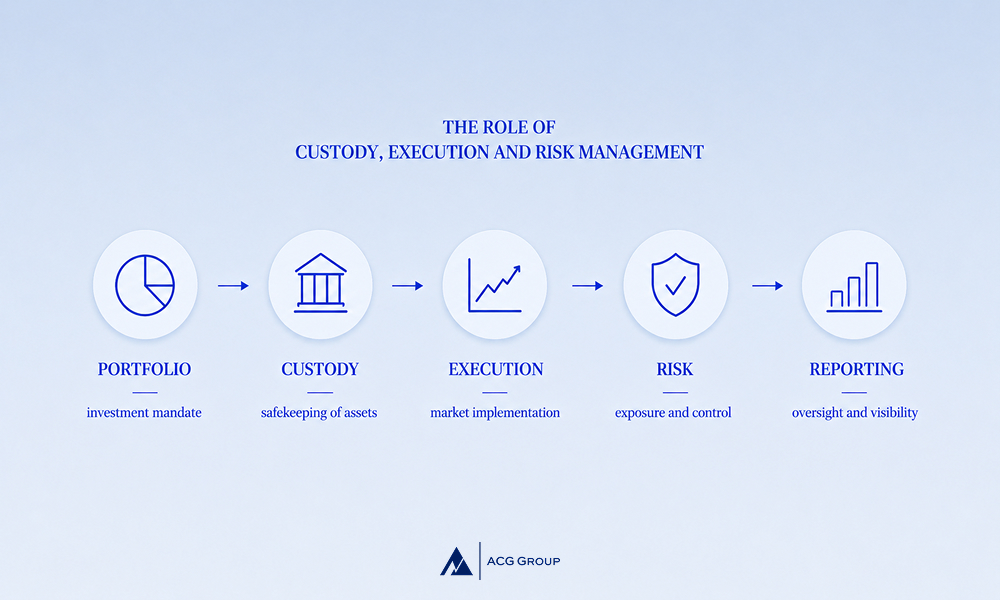
Portfolio decisions depend on the infrastructure used to hold assets, execute transactions, control risk and report results.
Effective custody services provide the safekeeping and administration of assets, while execution determines how efficiently investment decisions reach the market. Risk oversight helps monitor liquidity, concentration and exposures, and reporting gives investors visibility over portfolio activity and performance.
For sophisticated private clients and families, these functions can be just as important as the investment strategy itself.
Which Approach Do You Need?
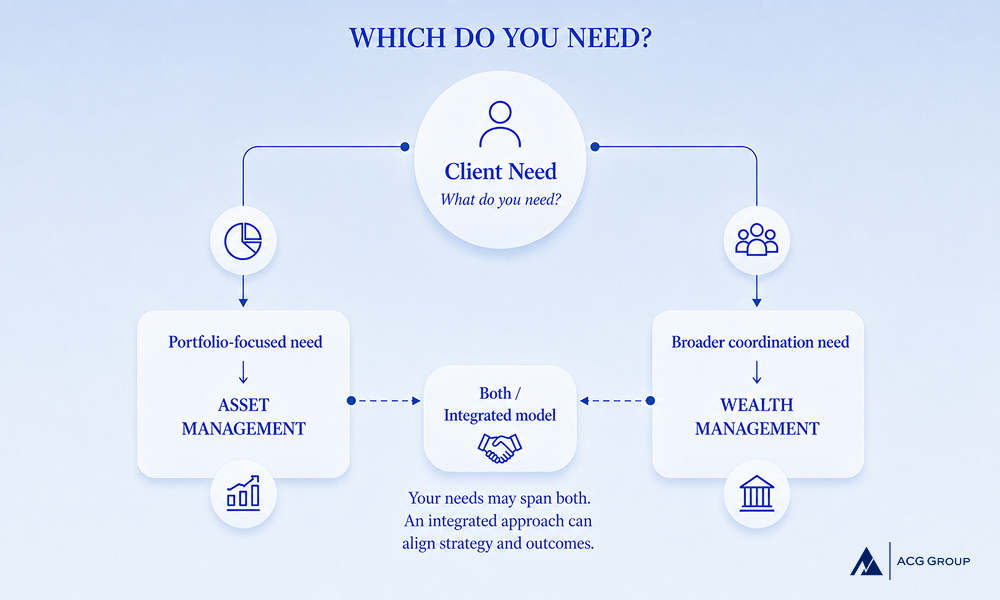
The answer depends on the complexity of the problem.
An investor whose primary requirement is to manage a defined investment portfolio may need specialist asset management.
A client whose wealth spans businesses, property, private investments, liquidity requirements and multiple family objectives may need a broader wealth-management framework.
Many private clients ultimately require both: strategic oversight of their overall wealth together with specialist asset management for individual portfolios.
ACG’s Approach
ACG Group combines private wealth management with institutional-grade investment capabilities, allowing portfolio decisions to be considered within a broader framework of wealth, risk and market infrastructure.
Our approach brings together investment management, custody services, trade execution and portfolio risk management, helping clients connect strategic wealth allocation with the specialist capabilities required to implement it.
For clients with more complex circumstances, this creates a framework in which investment portfolios can be managed alongside wider considerations around liquidity, concentration, ownership structures and long-term objectives.
Disclaimer
This newsletter is provided for informational and marketing purposes only and does not constitute investment advice, investment research, or an offer or solicitation to engage in any investment activity.
Past performance is not indicative of future results.
See full legal disclaimer.
For a more detailed discussion on how investors may position portfolios in light of the dynamics described above, please feel free to contact the ACG Team at: acg.group@acg.group
Prepared by
ACG Team